Showing posts with label Flybys. Show all posts

Monday, 12 June 2017

Mariner 10

     Mariner-10 was an American spacecraft launched on 3 November 1973 for a close flyby of planet Venus and Mercury. It was planned to measure the environment, atmosphere and surface of Mars. It was also aimed to perform gravity assist experiments between Mercury and Venus. Mariner-10 was designed under Bruce.C.Murray in Jet Propulsion Laboratory.Total duration of the mission is 1 Year, 4 Months and 12 Days.

Launch:

     Mariner-10 was carried by Atlas-Centaur  on 3 November 1973 at 12:45 UTC from SLC-36B launch pad. It injected Mariner-10 spacecraft into parking orbit, on the way to Venus the spacecraft separated from rocket. At first its camera were tested to take photograph of Earth and its moons. The spacecraft was tracked by Canopus Star. It also observed the Comet Kohoutek on 21 January 1974. It took 3 months to reach Venus.

Instruments Carried:
  • Television Camera
  • Infrared Radiometer
  • Ultraviolet Spectrometer
  • Plasma Detectors
  • Charged particle Telescopes
  • Magnetometer
  • Celestial Mechanics
  • Radio Science Experiment 
Television Camera:

The total weight of Television Camera is 43.6 kilograms. It consumed 67 watt of power from battery. The Camera only consumed more energy as compared to other five instruments. The camera system mounted in the spacecraft returned 7000 Photographs of Mercury and Venus during its mission of Mariner-10 flyby's.

Infrared Spectrometer:

 Infrared Spectrometer was used to detect the infrared radiation radiated by the surface of Mercury and Venus. By using this spectrometer the temperature of both planet surface was calculated. It also had a pair of Cassegrain telescopes and a detector made of Antimony-Bismuth thermopiles to measure as cold as -193 degree to 427 degree Celsius.

Ultraviolet Spectrometer:

UV-Spectrometer were involved in the measurement of UV absorption and UV emissions. It also calculated whether the solar radiation was absorbed at certain wavelengths which would indicate the presence of various gases in atmosphere.

Plasma Detectors:

The Plasma experiment was to detect and study the ionized gases of Sun's Solar wind and its temperature, density of electrons and to study how the planet was affected by solar plasma stream. By using this detector Mariner-10 collected first In Situ solar wind data from inside planet Venus.

Charged Particle Telescope:

The prime aim of this instrument is to observe the cosmic radiation interacted with heliosphere of Venus. It connected with plasma detectors and magnetometers to find some Magnetic fields of planet Mercury and Venus.

Magnetometers:

Magnetometer studied and analyzed the inter-planetary magnetic field of both planets during its flyby's. 

Celestial Mechanics and Radio Science Experiment:

This experiment was designed to investigate the mass and gravitational characteristics of Mercury. It was of particular interest, because of the planet is very close to the Sun.

Venus Flyby:

The spacecraft crossed planet Venus on 5 February 1974 at 17:01 UTC. It became 12th Spacecraft to reach Venus and Eighth to return data to Earth. Mariner-10 was programmed based on the data from Mariner-5 observations. Mariner-10 after reaching Venus it returned 4,165 useful photographs with lots of scientific information, atmospheric composition, geological features, Volcanoes, mountains,cloud features, creators etc..

The gravity assist experiment was also success on 5 February 1974. This changed the shape of spacecraft's elliptical orbit around the Sun. Image shown in left side is the processed clear image of Venus taken by Mariner-10 Spacecraft.

First Mercury Flyby:
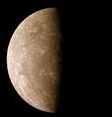
 Image Shows the processed image of Mercury by Mariner-10 spacecraft. Mariner-10 became the first mercury flyby. The first Mercury encounter took place on 29 March 1974 at 20:47 UTC. It flew Mercury for three times one on 21 September 1974 and another on 16 March 1975. After engineering tests on 24 March 1975, radio signal transmission ceased due to the depletion of nitrogen supply.So it was decommissioned on 24 MArch 1975. Since its launch it elapsed 1 year, 4 months and 12 days.

Discoveries:
  • Mariner-10 discovered evidence of rotating clouds and very weak magnetic field  
  • Using Ultraviolet filter, it found Venus Chevron clouds
  • It took 2,800 photographs of Mercury and revealed the Moon like surface on Mercury.
  • It discovered that atmosphere of Mercury mostly consist of Helium
  • It also detected some magnetic field and large iron-rich core.
  • Radiometer readings suggest that its night time temperature is -183 degree and daytime is 187 degree Celsius. 

Thursday, 30 March 2017

Mariner 6

 Mariner 6 is the second successful flyby of Mars by National Aeronautics and Space Administration NASA. It was launched on 25th February of 1969 at 01.29.02 UTC from Cape Canaveral Air Force Station. The Prime aim of this mission to analyse the atmosphere and surface of Mars.

LAUNCH:

       On 25th February 1969, Atlas SLV-3D Centaur-D1A Rocket carried Mariner 6 to its destination. This spacecraft.was manufactured by Jet Propulsion Laboratory of California Institute of Technology. After its Launch it was controlled by NASA tracking station.

INSTRUMENT CARRIED:

1. Infrared Spectrometer
2. Two channel IR Radiometer Mars Surface Temperature
3. Ultra-violet Spectrometer
4. S-band Occultation
5. Thermal control flux monitor
6. Mars Television Camera
7. Celestial Mechanics
8. General Relativity

TECHNICAL DETAILS:

1) The body of Mariner 6 was made with Magnesium Frame
2) Four solar panels produced 449 watt power for spacecraft
3) Communication were made with high gain parabolic antenna.
4) And through Omnidirectional low gain Antenna using S-band travelling tube amplifiers.
5) It was tracked by Canopus Tracker and a Star Canopus
6) Spacecraft position were adjusted with newton rocket motor with hydrazine fuel
7) Photovoltaic cells produced 800 watt of power near Earth and 449 watt after reaching Mars
8) It had a mounted 1200 watt Silver-Zinc Battery for power backup.
9) An Analog tape recorder of 195 million bits installed to collect data.
10) It had a capacity to perform 53 direct commands, 5 control commands and 4 quantitative commands.

SPACECRAFT'S DISCOVERIES:

     It flew over northern and southern region of Mars, and took photograph of northern giant volcanoes and a grand canyon. Later it found creators and canals. Totally it took 201 photographs and transmitted back to Earth. It gave much details ever than all earlier missions. It also studied the atmosphere of Mars.

Tuesday, 28 March 2017

Zond 2 Mars Flyby

    Zond 2 was Russian space probe sent to Mars. It was under Soviet's Zond Programme. It was a fifth attempt of Russia, but results in spacecraft failure due to the loss of communication before it's flyby. It was planned to take closeup image of Mars during its flyby in early 1964.

LAUNCH :

     Zond 2 Spacecraft is also known as 3MV-4 No.2. It was carried by Soviet Rocket series Molniya T103-16 from Baikanour launch station on 30th November 1964. It was very close to Mars on 6th August 1965. It was intended to analyse Mars atmosphere.

INSTRUMENTS CARRIED:

1. Phototelevision Camera
2. Two ultra-violet spectrometers
3. Infrared Spectrometer
4.PPT acutators

FUNCTIONS OF INSTRUMENTS:

     Phototelevision Camera mounted to take photograph of Mars. Ultra-Voilet spectrometers were planned to detect metals and biological macro molecules. Infrared Spectrometer was planned to detect signs of Methane.

REASON BEHIND FAILURE:

    The spacecraft ran on half power due to the loss of one of its Solar Panel. It was very close to Mars on 6th August 1965. Finally the communication between Zond 2 flyby and the Members of Zond Programme on August 6, 1965.

Sunday, 26 March 2017

Mariner 4 Spacecraft of Mars

INTRODUCTION:


                Mariner 4 was an American’s first successful spacecraft (Flyby) to reach Mars on 15thJuly 1965. It retains fourth number in the series of Mariner. It was designed for the interplanetary planet exploration. Mariner 4 was primarily intended for scientific observation of Mars during its close flybys and to transmit information back to Earth. This spacecraft became the first to return images from the deep space ever. Finally its communication was terminated on 21stDecember 1967.


STEPPING INTO ORBIT:


                Mariner 4 was launched on 28 November 1964, carried by Atlas LV-3 Agena-D rocket from Cape Canaveral Air force station at 14:22:01 UTC. This spacecraft was manufactured by Jet Propulsion Laboratory/JPL  of California. After its launch it was fully controlled and operated by NASA. It remained active for 3 years and 23 days of flyby around the Red planet (Mars). After its first image, it changed the view of scientific community to explore life on Mars.


INSTRUMENTS CARRIED:


  1. Cosmic dust detector                                    
  2. Cosmic ray telescope
  3. Geiger Counter / Ionization Chamber
  4. Helium Magnetometer
  5. Solar plasma probe
  6. Trapped Radiation Detector
  7. Television Camera

COMMUNICATION:


                Mariner 4 communicated to Earth by its High-gain parabolic antenna for long distance communication after reaching Mars and a omnidirectional low-gain antenna for short distance communication during its travel after the crossing Low Earth orbit (LEO)


FUNCTIONS OF INSTRUMENTS:


Helium Magnetometer                    To measure the magnitude and other interplanetary magnetic fields

Ionzation Chamber                          To measure the charged particle intensity around Mars

Trapped  Radiation detector        To measure intensity and direction of low-energy particles

Cosmic ray telescope                     To measure direction and energy spectrum of proton and alpha particles

Solar Plasma Probe                         To measure very low energy particles from Sun

Cosmic dust detector                     To measure momentum, distribution, density and direction of cosmic dust

Television camera                            To capture images of Mars


TECHNICAL DETAILS: 


  1. Solar panels of Mariner 4 could provide 310 watts at the distance of Mars
  2. It had a rechargeable 1200 w-h Silver-zinc battery for Power
  3. Monopropellant Hydrazine was used for propulsion ( 222-Newton Motor 50lbf )
  4. The attitude control was performed by 12-Cold nitrogen gas jets
  5. It was tracked and navigated by the four sun sensors and the star Canopus
  6. Data recorded in a magnetic tape recorder of 5.24 million bits
  7. Precision tracking was done based on Celestial Mechanics


RESULTS:

  1. Total data returned my Mariner 4 was around 634 Kb
  2. Images showed Moon like creator on Mars
  3. Atmospheric pressure of   410 to 740 pascals was found
  4.  Daytime temperature of -373 Kelvin was found
  5. No Magnetic field and radiation belts were detected
  6.  Its photographs helped for Mars Geologic History

Thursday, 9 February 2017

Mariner 3

Name            :Mariner 3
Launch         :05 November 1964
Rocket  Atlas: LV-3 Agenda D
Launch site  :Cape Canaveral
Last Contact : 6 November 1964

Mission Overview:-


           Mariner 3 was launched in 5 November of 1964. It was aimed to flyby around mars and conduct interplanetary experiments along way. Soon after its launch, the shroud encasing the spacecraft at top of rocket failed to open properly which results in the mission unsuccessful.


     Three weeks later Mariner 4 was successfully launched. And after eight month of journey to the Red planet, it collected the first closeup photograph of other planet.

Causes for failure of Spacecraft:-


     After one hour of launch transmission was received indicating the functioning of the instrument, but there is no indication of Solar panel functioning which results in the power failure. Battery dead and the spacecraft ran out of power.. ( spacecraft failure )


Instruments Carried:-

  1. Imaging system
  2. Magnetometer
  3. Plasma Probe
  4. Cosmic ray telescope
  5. Trapped Radiation detector
  6. Cosmic Ray Ionization
  7. Cosmic Dust Detector

Wednesday, 1 February 2017

Mars 1 Flyby

Spacecraft Details:-

Name                         : Mars 1
Launch                     : 1 November 1962
Owner                      : Russia
Rocket                     : Molniya
Type                         : Probe / Flyby
Closest approach : 19 June 1963 

Description:-
                          Mars 1 also known as 1962 Beta No.1 Mars2MV-4 and Sputnik-23. It was launched on 1 November of 1962 as a part of Soviet Mars Programme with intent flyby of Mars at 11,000 Km. 

Objectives:-
  
          It was aimed to take image of Martian Surface and send back Cosmic data to the earth. It also designed to study the Mars Magnetic field, Mars Radiation Environment, Atmosphere structure and possible organic compunds.
Mission Status:-

          After leaving the earth Low Earth Orbit rocket Molniya's fourth stage separated and solar panel was deployed. Early telementry indicated that there was leak in one of the gas valve in the orientation system. So that the spacecraft transferred to gyroscopic stabilization. Later using Sixty One radio transmitters large amount of data were collected.

Causes for Failure:

             On 21st March 1963, the spacecraft is 106,760,000 km from the earth and on the way to Mars, thereafter the communication between Mars 1 and Telementry ceased,  probably due to the failure of spacecrafts antenna orientation system.
Scientific Results from Mars-1:
  1. It recorded one of the micrometeorite outside Earth.
  2. Magnetic field intensities of 3-4 nano teslas were detected.
  3. Solar wind was detected.
  4. Radiation Zone around the Earth was detected.          
Memories:-

               In later period Soviet Union published Mars 1 Stamp to remember the spacecraft. It was the spacecraft which lost its contact before flyby and it was close to Mars at a distance of 193,000 km.

Monday, 30 January 2017

Mars 2MV-4 No.1

Mars 2MV-4 No.1
Name         : Mars 2MV-4 No.1
 Launch      : 24 Oct 1962
Owner        : Roscosmos
Type           : Flyby
Rocket       : Molniya
Decay Date : 26 Feb 1963

Description:
                 
                   Mars 2MV-4 No.1 was also known as Sputnik-22 which was a Soviet Union's Spacecraft launched in 24th October of 1962 as a part of Soviet Mars Programme. It was planned to make Mars flyby and transmit images of Mars to Earth. But due to the problem in carrier Rocket, it was destroyed in the Low Earth Orbit. It was the first of two Mars 2MV-4 spacecrafts to be launched and other Mars 1 later after 8 days.

Designations:
                   
                      The designation of Sputnik 29 and later Sputnik 22 were used by United State Naval Command to identify the spacecraft in its Satellite Situation Summary documents, since the Soviet union did not release the designations of its Spacecraft at that time, and had not assign it an official name due to its failure to depart geocentric orbit.

Saturday, 28 January 2017

Mars 2M Flyby


Name              : Mars 2M Flyby
Launch date    : 14 October 1960
Operator          : Russia
Type                : Flyby
Carrier Rocket  : Molniya
Mission status   : Failure

Mission Description :-

      Mars 2M Flyby otherwise called Mars 1M No.2 designated as Mars 1960B by NASA analyst. It was launched as a part of Soviet Unions Mars Programme after four days of sister launch Mars 1M Flyby which lost in launch failure in 1960.

Mission Objective:-

         Mars 2M was aimed to perform flyby of Mars, but it was destroyed after its Molniya carrier rocket failed to achieve orbit.

Causes for failure of Spacecraft:-

         During preparation of launch, an oxidizer leak in the second stage caused liquid oxygen at cryogenic temperature, to spill around the engine's fuel inlet valve which made the rocket unable to ignite. As a result spacecraft failed to achieve earth's orbit.

Friday, 27 January 2017

Mars 1M Flyby


                                First Step to Mars Ever  

Spacecraft Description:-
Name                            : Mars 1M Flyby
Launch                       : 10 Oct 1960
Type of Spacecraft    : Flyby
Mission Status        : Mission failure
Carrier Rocket       : Molniya
Power Source       : Silver-Zinc Batteries

                The Mars 1M Flyby otherwise called Mars IM No.1 which is designated as Mars 1960A by NASA. It was the first attempt to launch as a part of Soviet Union's programme to Study Mars.

  Mission Objective:-  

                     The main objective of Mars 1M Flyby is to study the space between the Earth and Mars. And to take the Surface image of Mars. Another objective of this mission is to test the radio communication systems from Mars to Earth.

Instruments Carried:-
  1. Magnetometer
  2. Cosmic ray Counter
  3. Plasma ion Trap
  4. Radiometer
  5. Micrometeorite detector
  6. Spectroreflectometer
  7. Photo television Camera                                                  
 Mission Status:-

                  The Mars IM Flyby failed to orbit because of launch failure carried by Molniya Rocket on 10th October 1960.