Wednesday, 14 June 2017

HXMT - China First Telescope Launch

HXMT - HARD X-RAY MODULATION TELESCOPE (CHINA ASTRONOMICAL OBSERVATORY)

Today China launches HXMT Mission for its X-Ray based astronomical Observation. It will observe black holes, neutron stars and other gas nebulae based on its X-Ray and Gamma-Ray emissions. It is the China's First Astronomical Satellite. And it is based on the series of reconnaissance satellite JianBing-3 

The Project is a joint mission of the Ministry of Science and Technology of China and the Chinese Academy of Sciences and Tsinghua University. It took 17 years to construct completely. 

#For more space launch schedule visit our page  Space-Flight Schedule

Messenger

Messenger Spacecraft around Mercury
    MESSENGER - Mercury Surface Space Environment was an Robotic spacecraft of NASA which orbited Mercury between 2011 and 2015 to study Mercury Chemical Composition, geology and magnetic field.It became second spacecraft to orbit around Mercury after Mariner-10 in 1975. It performed its first flyby in January 2008 and entered its orbit around 18 March 2011. It final mission ends in 30 April 2015 by impacting into Mercury's surface.


 LAUNCH:

MESSENGER was carried by Delta-II 7925H Rocket on 3 August 2004 at 06:15:56 UTC from Cape Canaveral. It was aimed to perform multiple flyby around Venus and Mercury. 
OBJECTIVES:

Some of the objectives of Messenger mission was
  1. To characterize the chemical composition of the surface of Mercury
  2. To study detailed about Mercury's geologic history
  3. To study the planet Magnetic field and its Magnetosphere
  4. To identify the size and core state of the planet
  5. To study its volatile poles and exosphere of Mercury
SCIENTIFIC INSTRUMENTS:
  • MDIS   - Mercury Dual Imaging System
  • GRS     - Gamma-Ray Spectrometer
  • NS        - Neutron Spectrometer
  • XRS      - X-Ray Spectrometer
  • MAG     - Magnetometer
  • MLA      - Mercury Laser Altimeter
  • MASCS - Mercury Atmospheric and Surface Composition Spectrometer
  • EPPS     - Energetic Particle and Plasma Spectrometer
  • RS          - Radio Science
EARTH FLYBY:

MESSENGER performed first Earth flyby one year after launch on 2 August 2005. During its flyby it took photograph of Earth to test its working of the instruments properly. All the onboard instruments worked properly.

(Image: Earth Image taken by Messenger during its flyby around Earth)


VENUS FLYBY:

Venus
MESSENGER encountered Venus on 24 October 2006 at 08:34 UTC. During this encounter Messenger entered super conjuction where Earth was on exact opposite side of the Solar system. During this interval no radio communication and observation were made

It encountered Venus again on 5 June 2007, at this time Messenger studies upper atmosphere of Venus using Infrared Imaging spectrometer, Ultra-violet spectrometer and X-Ray Spectrometer. 

(Image : Photo of Venus taken by Messenger Spacecraft


MERCURY FLYBY:

Mercury
  MESSENGER made its first flyby of Mercury on 14 january 2008 and its second flyby on 6 October 2008. It entered safe mode sometime and was recovered seven hours later on 24 November 2009 at 22:45 UTC.

Image: First image of Mercury by Messenger on its first flyby 


MISSION OUTCOMES:

Messenger found large amount of water present in Mercury's exosphere.In later years it found volcanic activity on the surface of Mercury and liquid planetary iron core. It also detected Organic compounds and water ice inside craters near the north pole.

END OF MISSION:

The Messenger mission was ended on 30 April 2015 at 3:40 UTC. It impacted and crashed on the surface. Lost of spacecraft is due to the insufficient supply of helium gas to pressurize the propellant tanks. There were no images taken to map the area of impact site. 

Last Image of Messenger Spacecraft before Impact
     

Tuesday, 13 June 2017

Cool Dust around Energetic Active Black Holes

Dust around Active Black Holes
     Researchers from the University of Texas, San Antonio found cool dust around energetic active black holes during their observation from NASA's Stratospheric Observatory for Infrared Astronomy (SOFIA). 

Large galaxies has massive black holes at their center which are quiet like a black hole in the center of our Milkyway galaxy. The draw many materials and emit large amount of energy. They are called active galactic nuclei. SOFIA team have found 11 supermassive black holes in galactic nuclei which are located at a distance of 100 million light years from our Earth. They are of donut-shaped structure called Torus. This discovery has been published in the paper Monthly Notices of the Royal Astronomical Society

ABOUT SOFIA:

     SOFIA is a Boeing 747SP Jetliner modified to carry a 100-inch diameter telescope. It is a point projection of NASA and German Aerospace Center. NASA's Amnes Research center in California's Silicon Valley manages the SOFIA program. Science and Space mission operations are in cooperation with Universities Space Research Association headquartered in Columbia, Maryland and the German SOFIA Institute at the University of Stuttgart. The aircraft is based at NASA's Armstrong Flight Research Center's Hangar 703, in Palmdale, California.

Text Credit    : NASA  
Image Credit : SOFIA   

Gamma-Ray Spectrometer

     Gamma-Ray Spectrometer is an instrument to measure the distribution of gamma radiation. The Study and analysis of gamma-ray spectra is called as Gamma-Ray Spectroscopy. This spectrometer used in spacecrafts to observe and collect data by measuring the energy of each photon. Electromagnetic radiation is directly proportional to its frequency. Hence photons are counted typically by this spectrometer.


NOTABLE SPACECRAFT FOR THIS PAYLOAD:
  • Messenger
  • Apollo 16
  • 2001 Mars Odyssey

Thermal Infrared Spectrometer

     Thermal Infrared Spectrometer is a type of Infrared Spectrometer which emits radiation in the infrared part of electromagnetic spectrum. It measures the thermal infrared radiation emitted from the Sample solution or Land Surface. This instrument is mostly used in planet exploration types of spacecraft to detect or identify the composition of surface and sample solutions. It has  airborne and spaceborne applications.
 
AIRBORNE SPECTROMETER TYPE:

  • TIMS - Multispectral Radiometer 
  • SEABASS -  Hyperspectral Spectrometer
  • Hyper-Cam - Hyperspectral Thermal Infrared Camera
  • OWL - Hyperspectral Thermal Infrared Camera 
SPACEBORNE SPECTROMETER TYPE:
  • ISM - Imaging Spectrometer carried by Russian's Phobos 2 Spacecraft 
  • ASTER - Multispectral Radiometer carried by Earth Observing Satellite "Terra"
  • TIS - Spectrometer carried by Mangalyaan
  • TES - Hyperspectral Spectrometer  carried by NASA's Mars Global Surveyor spacecraft
  • Mini-TES - Small Version of spectrometer mounted on NASA's both Mars Exploration Rovers
  • THEMIS - A Multispectral Thermal Infrared Imager carried by 2001 Mars Odyssey Spacecraft. 

R-136 Cluster of Magellanic Nebulae

 This Magnificent Image of R136 Cluster was taken by Hubble Space Telescope in Great Magellanic Nebula. This cluster is located about 170,000 light years away from Earth. This R136 cluster has very large, hot and bright stars. Astronomers have found nine stars in that cluster which is 100 times the quality of the Sun in bright also.

Monday, 12 June 2017

Hayabusa-2

     Hayabusa-2 Mission to Asteroid to clarify the origin and evolution of Solar System as well as life in our universe.This spacecraft is also known as "Asteroid Explorer" which is the creation of several new technologies. Hayabusa-2 is a successor of Hayabusa (MUSES-C). It will target C-Type asteroid Ryugu to study the origin and evolution of Solar system as materials for life by leveraging the experience acquired from the Hayabusa mission. It was launched on 3 December 2014 and aimed to arrive the C-type asteroid in mid of 2018. It will do its observations till 2019 and will return to Earth around the end of 2020.

Major Onboard Instruments:
  • Electric propulsion system (ion engine)
  • Sample Mechanism
  • Target markers
  • Re-entry Capsule
Mission Instruments:
  • Small Carry-on Impactor
  • Near Infrared Sprectrometer
  • Thermal Infrared Imager
  • Small Rovers [MINERVA-II-1 and MINERVA-II-2]
  • Small Lander [MASCOT] 

Mariner 10

     Mariner-10 was an American spacecraft launched on 3 November 1973 for a close flyby of planet Venus and Mercury. It was planned to measure the environment, atmosphere and surface of Mars. It was also aimed to perform gravity assist experiments between Mercury and Venus. Mariner-10 was designed under Bruce.C.Murray in Jet Propulsion Laboratory.Total duration of the mission is 1 Year, 4 Months and 12 Days.

Launch:

     Mariner-10 was carried by Atlas-Centaur  on 3 November 1973 at 12:45 UTC from SLC-36B launch pad. It injected Mariner-10 spacecraft into parking orbit, on the way to Venus the spacecraft separated from rocket. At first its camera were tested to take photograph of Earth and its moons. The spacecraft was tracked by Canopus Star. It also observed the Comet Kohoutek on 21 January 1974. It took 3 months to reach Venus.

Instruments Carried:
  • Television Camera
  • Infrared Radiometer
  • Ultraviolet Spectrometer
  • Plasma Detectors
  • Charged particle Telescopes
  • Magnetometer
  • Celestial Mechanics
  • Radio Science Experiment 
Television Camera:

The total weight of Television Camera is 43.6 kilograms. It consumed 67 watt of power from battery. The Camera only consumed more energy as compared to other five instruments. The camera system mounted in the spacecraft returned 7000 Photographs of Mercury and Venus during its mission of Mariner-10 flyby's.

Infrared Spectrometer:

 Infrared Spectrometer was used to detect the infrared radiation radiated by the surface of Mercury and Venus. By using this spectrometer the temperature of both planet surface was calculated. It also had a pair of Cassegrain telescopes and a detector made of Antimony-Bismuth thermopiles to measure as cold as -193 degree to 427 degree Celsius.

Ultraviolet Spectrometer:

UV-Spectrometer were involved in the measurement of UV absorption and UV emissions. It also calculated whether the solar radiation was absorbed at certain wavelengths which would indicate the presence of various gases in atmosphere.

Plasma Detectors:

The Plasma experiment was to detect and study the ionized gases of Sun's Solar wind and its temperature, density of electrons and to study how the planet was affected by solar plasma stream. By using this detector Mariner-10 collected first In Situ solar wind data from inside planet Venus.

Charged Particle Telescope:

The prime aim of this instrument is to observe the cosmic radiation interacted with heliosphere of Venus. It connected with plasma detectors and magnetometers to find some Magnetic fields of planet Mercury and Venus.

Magnetometers:

Magnetometer studied and analyzed the inter-planetary magnetic field of both planets during its flyby's. 

Celestial Mechanics and Radio Science Experiment:

This experiment was designed to investigate the mass and gravitational characteristics of Mercury. It was of particular interest, because of the planet is very close to the Sun.

Venus Flyby:

The spacecraft crossed planet Venus on 5 February 1974 at 17:01 UTC. It became 12th Spacecraft to reach Venus and Eighth to return data to Earth. Mariner-10 was programmed based on the data from Mariner-5 observations. Mariner-10 after reaching Venus it returned 4,165 useful photographs with lots of scientific information, atmospheric composition, geological features, Volcanoes, mountains,cloud features, creators etc..

The gravity assist experiment was also success on 5 February 1974. This changed the shape of spacecraft's elliptical orbit around the Sun. Image shown in left side is the processed clear image of Venus taken by Mariner-10 Spacecraft.

First Mercury Flyby:

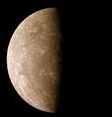
 Image Shows the processed image of Mercury by Mariner-10 spacecraft. Mariner-10 became the first mercury flyby. The first Mercury encounter took place on 29 March 1974 at 20:47 UTC. It flew Mercury for three times one on 21 September 1974 and another on 16 March 1975. After engineering tests on 24 March 1975, radio signal transmission ceased due to the depletion of nitrogen supply.So it was decommissioned on 24 MArch 1975. Since its launch it elapsed 1 year, 4 months and 12 days.

Discoveries:
  • Mariner-10 discovered evidence of rotating clouds and very weak magnetic field  
  • Using Ultraviolet filter, it found Venus Chevron clouds
  • It took 2,800 photographs of Mercury and revealed the Moon like surface on Mercury.
  • It discovered that atmosphere of Mercury mostly consist of Helium
  • It also detected some magnetic field and large iron-rich core.
  • Radiometer readings suggest that its night time temperature is -183 degree and daytime is 187 degree Celsius. 

Magnificent view of the Universe

     Hubble Space Telescope, when launched it became a hope for many scientific observations for the Astronomers. From its day of launch it had made millions of observations and discoveries. On its 27th Anniversary it showed a magnificent view of the Universe. The last end of the galaxy is NGC 4302 and the spiral galaxy is NGC 4298. But the pinwheel galaxy is quite different, because they angled in different positions in the Universe and they are very similar in structure and course.


Hubble Space Telescope is collaborative mission between NASA and ESA, from beginning it had made millions of observations since its launch.

Sunday, 11 June 2017

Geostationary Satellite GSAT-19 Indian Communication Satellite

     GSAT-19 satellite was launched from Second launch pad at Satish Dhawan Space Centre (SHAR) in Sriharikotta. It was carried by GSLV-Mark-III-D1 on 05 June 2017.

 GSAT-19 satellite is a communication satellite of India, it was launched with a mass of 3136kg configured with ISRO's Standard I-3K bus.

GSAT-19 carries Ka/Ku band-width throughout the communication transpoders. It also carried Geostationary Radiation Spectrometer (GRASP) payload to monitor the charged particle and the influence of space radiation on orbiting satellites and their electronic components. GSAT also features certain advanced spacecraft technologies including miniaturised heat pipe, fibre optic gyro, Micro Electro-Mechanical Systems (MEMS) accelerometer, Ku bandwidth transpoder and well indegenous Lithium-ion Battery.

GSLV-Mark-III-D1 at Liftup Stage India