Friday, 23 June 2017

Hubble to Capture galaxy with Gravitational Lens

Hubble Space Telescope shows fast-spinning disk shaped galaxy
     Hubble Space Telescope uses Gravitational Lens to Capture fast spinning Disk Galaxy. Gravity of a massive galaxy cluster MACS J2129-0741 brightens and magnifies the far distant galaxy in the background galaxy MACS2129-1 in the upper right corner of the image. Astronomers of NASA have made a amazing discovery of fast spinning disk shaped galaxy using power of natural lens of Hubble Space Telescope. These galaxy were called dead galaxies. Because they stopped forming stars before few billion years ago.

Image Credit: NASA, ESA

Wednesday, 21 June 2017

New Catalog of Exoplanets by Kepler Space Telescope

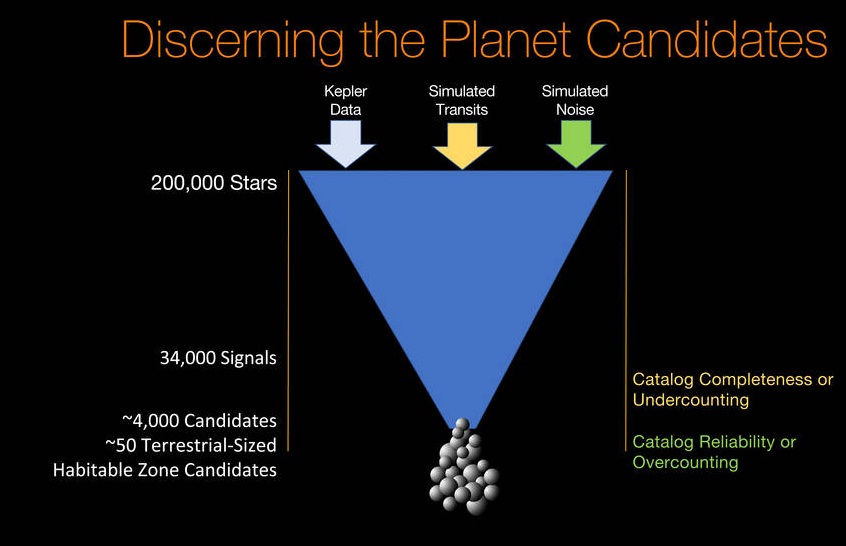
     Team of NASA's Kepler Space Telescope team has released a catalog containing 219 new planets, 10 of which are Earth seized orbiting the star in the habitable zone.This is a detailed catalog containing many exoplanets outside our solar system. It is also a final spacecraft view of constellation Cygnus.

NASA's Exoplanet Archive contains 4,034 planets identified by Kepler Space Telescope and 2,335 planets are verified exoplanets. 50 planets were lie in the habitable zone. One of the most amazing discovery of Kepler Space Telescope is TRAPPIST-1 system and its seven Earth seized planets.

Assemble Line of Exoplanets discovered by Kepler Space Telescope
Exoplanet Missions of NASA

Exoplanet Populations Chart

Kepler New Planet Candidates

Planets which lie in the Habitable Zone by Kepler Space Telescope of NASA


 Image Credit : Kepler Space Telescope
Catalog Credit: NASA Kepler Team

More Information on Kepler Catalog release at Kepler Catalog Release

Saturday, 17 June 2017

Colored Clouds of Jupiter

     NASA's Juno Jupiter Spacecraft was moving away from Jupiter following its seventh close pass. JunoCam imaged this on 19 May 2017 from about 29,100 miles above the cloud tops.

     The Images shows variety in Jupiter's Stormy atmosphere. The result is a surreal world of vibrant color, clarity and contrast. Four of the Oval white storms is known as String of Pearls. These storms are visible near the top of the image. There is one more orange-colored storm can be seen at the belt-zone, while other storms are cream color.

More Information of Juno at NASA Juno Mission

Cyclone in Jupiter

 Jupiter's Polar cyclones producing auroras, this image was taken by Juno spacecraft of NASA. Juno was sent to study Jupiter's atmosphere, auroras, storms, and both poles. It takes a long time to carry a research on Jupiter. Juno entered Jupiter's orbit on 4 July 2016, and the primary aim is understand the evolution of Jupiter and the reason for the strong magnetic field. It continuously monitors the polar storms in polar regions. It makes a close flyby once in every 53 days.The next close flyby is on 11 July 2017, and it will fly across most iconic features in our entire solar system. Image Shows that, the cyclones have been formed by the large ammonia gas moving and crashing each other. Glowing North Pole of Jupiter is looking like bright Auroras.

Hubble's Spirograph IC418 Nebulae


IC 418 Nebulae from Hubble Space Telescope
     A Hubble Image showing planetary nebula IC 418 glows like multifaceted jewel. It lies about 2000 light years away from our Earth in the constellation Lepus. This planetary nebula indicates the final stage of Star Evolution similar to our Sun. The center of the Star was red before few billion years ago, but now expanded to a diameter of 0.1 light-year. The stellar remnant at the center is hot core from which ultraviolet radiation flows from center to surrounding gas.

Over few thousands year, the nebula will gradually disperse into space, and the star will cool and fade away to become a white dwarf. Our Sun will undergo same procedure after next 5 million years.This image is filtered with several color filters. Red shows emission of Nitrogen, Green shows emission of Hydrogen, Blue shows emission of Ionized Oxygen. 

Top 10 Discoveries of MAVEN

     MAVEN is an American Spacecraft which was launched in 2013 and inserted into Martian Orbit on September 2014. Since its launch it have been exploring Mars Upper atmosphere. MAVEN has made wonderful discoveries of upper atmosphere of Mars, NASA celebrated its 1000 days of orbit around Mars on 17 June 2017. Top 10 discoveries of MAVEN were
  • Imaging Showed that distribution of Nitric Oxide and Ozone in the upper atmosphere which shows Complex behavior and indicates that exchange of gases takes place between upper and lower atmosphere.
  • Particles from Solar Wind unexpectedly penetrate into upper atmosphere instead of diverted by planet's ionosphere. This particles react with charged particles in ionosphere and convert into neutral atoms that are able to penetrate deeply.
  • MAVEN detected the first observations Metal ion layer in the Martian ionosphere.
  • It identified Two new types of auroras which are named "Diffuse" and "Proton" aurora. These auroras are not similar to auroras in our Earth.
  • These aurorae are caused by influx of Solar particles ejected by various types of Solar Storms.
  • The interactions between Solar wind and planet are Complex. This results in the lack of intrinsic Martian Magnetic field and occurrence of small Magnetized crust that can affect incoming solar wind on local scales.
  • MAVEN observed seasonal variations of Hydrogen atoms in upper atmosphere by a factor of 10 throughout whole year. The source of Hydrogen is water present in the lower atmosphere that are broken down into Hydrogen and Oxygen by Sunlight.
  • It also used of isotopes in upper atmosphere and suggested that 2/3 or more gases has been lost to space.
  • MAVEN has measured the rate of stripping gases from top of atmosphere to space along with the process of removal and revealed that large amount of gas have lost to space.
  • The Mars atmosphere has been stripped away by the Sun and the Solar Wind. This results in the change of climate from warm to wet environment, early in History to cold and dry climate that we see today.
Credit: MAVEN Team, NASA and Goddard Space Flight Center.

Thursday, 15 June 2017

Kosmos 419

Kosmos 419 was also known as 3MS-No.170 orbiter. It was a failed Soviet spacecraft to Mars. It was launched on 10 May 1971 from Baikanour launch pad, Russia and Kosmos was carried by Proton K/D rocket. Due to malfunction of rocket engine, it decayed in low earth orbit after launch on 12 May 1971.


SIMULTANEOUS MISSION:

     Simultaneously United states and Russia made new attempts to reach Red planet. Mariner8 and Mariner9 of NASA, Kosmos 419 of Russia. But Mariner-8 lost in launch failure two days before Kosmos 419 was launched. This spacecraft also lost on 12 May 1971. Mariner-9 became the first spacecraft to orbit Mars.

REASON FOR LAUNCH FAILURE:

     Proton K/D's Block-D ignition timer was incorrectly set. It was set to ignite 1.5 years after launch instead of 1.5 hours.

BepiColombo

     
     BepiColombo will become third spacecraft to Mercury scheduled to launch in October 2018.. It is a joint mission between European Space Agency and Japan Aerospace Exploration Agency to the Mercury. This mission comprises of two satellite Mercury Planetary Orbiter and Mercury Magnetospheric Orbiter. This satellites will study Mercury's magnetic field,magnetosphere and Interior structure. 

MISSION OBJECTIVES:
  • To study the origin and evolution of Mercury
  • To study planet's interior structure, geology, composition and craters
  • To study mercury's exosphere composition and dynamics
  • To study planets Magnetosphere and origin of Mercury magnetic field
  • To verify the Einstein's theory of relativity by measuring gamma and beta parameters
COMPONENTS

BepiColombo has two components.They are
  1. Mercury Transfer Module
  2. Mercury Planetary Orbiter
SCIENTIFIC INSTRUMENTS:
  • BELA - BepiColombo Laser Altimeter
  • ISA -Italian Spring Accelerometer
  • MERMAG - Mercury Magnetometer
  • MERTIS - Mercury Thermal Infrared Spectrometer
  • MGNS - Mercury Gamma ray and Neutron Spectrometer
  • MIXS - Mercury Imaging X-Ray Spectrometer
  • MORE - Mercury Orbiter Radio Science Experiment
  • PHEBUS - Probing of Hermean Exosphere by Ultraviolet Spectroscopy
  • SERENA - Neutral and Ionised particle Analyser
  • SIMBIO-SYS - Spectrometers and Imager
  • SIXS - Solar Intensity X-Ray Spectrometer 
INSTRUMENTS OF MMO (Mercury Magnetospheric Orbiter)
  •  MPPE - Mercury Plasma Perticle Experiment
    • MEA - Mercury Electron Analyser
    • MIA - Mercury Ion Analyser
    • MSA - Mass Spectrum Analyser
    • HEP-Ion - High Energy Ions
    • HEP-ele - High Energy Electrons
    • ENA - Energetic Neutrals Analyzer
  • MGF - Magnetic Field Investigation
  • PWI - Plasma Wave Investigation
  • MSASI - Mercury Sodium Atmosphere Spectral Imager
  • MDM - Mercury Dust Monitor
   BepiColombo will be launched from Guiana Space Center using Ariane 5 Rocket which was contracted by Ariane Space Agency on October 2018 as planned. The spacecraft will be operated by European Space Agency and Japan Space Agency (JAXA). Duration of the mission is planned for one year but may be extended depend on the fuel and working efficiency.

    Wednesday, 14 June 2017

    HXMT - China First Telescope Launch

    HXMT - HARD X-RAY MODULATION TELESCOPE (CHINA ASTRONOMICAL OBSERVATORY)

    Today China launches HXMT Mission for its X-Ray based astronomical Observation. It will observe black holes, neutron stars and other gas nebulae based on its X-Ray and Gamma-Ray emissions. It is the China's First Astronomical Satellite. And it is based on the series of reconnaissance satellite JianBing-3 

    The Project is a joint mission of the Ministry of Science and Technology of China and the Chinese Academy of Sciences and Tsinghua University. It took 17 years to construct completely. 

    #For more space launch schedule visit our page  Space-Flight Schedule

    Messenger

    Messenger Spacecraft around Mercury
        MESSENGER - Mercury Surface Space Environment was an Robotic spacecraft of NASA which orbited Mercury between 2011 and 2015 to study Mercury Chemical Composition, geology and magnetic field.It became second spacecraft to orbit around Mercury after Mariner-10 in 1975. It performed its first flyby in January 2008 and entered its orbit around 18 March 2011. It final mission ends in 30 April 2015 by impacting into Mercury's surface.


     LAUNCH:

    MESSENGER was carried by Delta-II 7925H Rocket on 3 August 2004 at 06:15:56 UTC from Cape Canaveral. It was aimed to perform multiple flyby around Venus and Mercury. 
    OBJECTIVES:

    Some of the objectives of Messenger mission was
    1. To characterize the chemical composition of the surface of Mercury
    2. To study detailed about Mercury's geologic history
    3. To study the planet Magnetic field and its Magnetosphere
    4. To identify the size and core state of the planet
    5. To study its volatile poles and exosphere of Mercury
    SCIENTIFIC INSTRUMENTS:
    • MDIS   - Mercury Dual Imaging System
    • GRS     - Gamma-Ray Spectrometer
    • NS        - Neutron Spectrometer
    • XRS      - X-Ray Spectrometer
    • MAG     - Magnetometer
    • MLA      - Mercury Laser Altimeter
    • MASCS - Mercury Atmospheric and Surface Composition Spectrometer
    • EPPS     - Energetic Particle and Plasma Spectrometer
    • RS          - Radio Science
    EARTH FLYBY:

    MESSENGER performed first Earth flyby one year after launch on 2 August 2005. During its flyby it took photograph of Earth to test its working of the instruments properly. All the onboard instruments worked properly.

    (Image: Earth Image taken by Messenger during its flyby around Earth)


    VENUS FLYBY:

    Venus
    MESSENGER encountered Venus on 24 October 2006 at 08:34 UTC. During this encounter Messenger entered super conjuction where Earth was on exact opposite side of the Solar system. During this interval no radio communication and observation were made. 

    It encountered Venus again on 5 June 2007, at this time Messenger studies upper atmosphere of Venus using Infrared Imaging spectrometer, Ultra-violet spectrometer and X-Ray Spectrometer. 

    (Image : Photo of Venus taken by Messenger Spacecraft) 


    MERCURY FLYBY:

    Mercury
      MESSENGER made its first flyby of Mercury on 14 january 2008 and its second flyby on 6 October 2008. It entered safe mode sometime and was recovered seven hours later on 24 November 2009 at 22:45 UTC.

    Image: First image of Mercury by Messenger on its first flyby 


    MISSION OUTCOMES:

    Messenger found large amount of water present in Mercury's exosphere.In later years it found volcanic activity on the surface of Mercury and liquid planetary iron core. It also detected Organic compounds and water ice inside craters near the north pole.

    END OF MISSION:

    The Messenger mission was ended on 30 April 2015 at 3:40 UTC. It impacted and crashed on the surface. Lost of spacecraft is due to the insufficient supply of helium gas to pressurize the propellant tanks. There were no images taken to map the area of impact site. 

    Last Image of Messenger Spacecraft before Impact